SAHELI
SAHELI
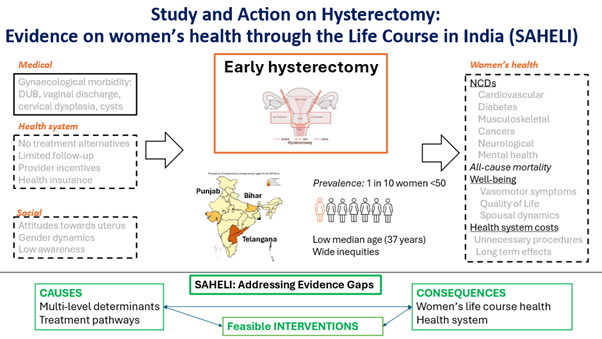
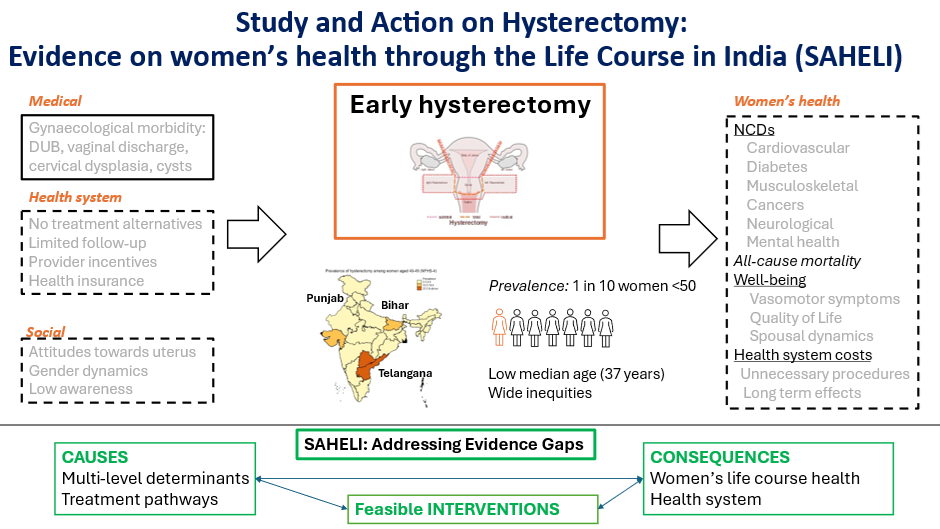
SAHELI: Study and Action on Hysterectomy: Evidence on women’s health through the Life Course in India is a five-year, multi-disciplinary study to examine the causes and consequences of hysterectomy and identify feasible interventions to improve women’s health.
SAHELI is grounded in feminist epidemiology: we prioritise integrating the voices of women at each stage of our multi-disciplinary research and evidence translation. We aim to engage a wide range of stakeholders to identify feasible interventions at the community, clinical and health systems levels in India and similar settings.
Objectives
The SAHELI Team Science project explores the causes and consequences of early hysterectomy through four research questions:
- What are the individual, social and health system determinants of early hysterectomy in India?
- What are the treatment pathways and key influences that determine women’s journeys from clinical diagnosis to hysterectomy?
- What are the consequences of undergoing early hysterectomy on women’s physical, mental, economic, and social well-being across the life course?
- What are feasible clinical, health system and community interventions at the primary, secondary, and tertiary level to address unnecessary hysterectomy?
Methods
SAHELI is conducting a mixed-methods study on women’s health, with a focus on the causes and consequences of early hysterectomy in Telangana, Bihar and Punjab. It will involve:
- A population-based quantitative survey in three states, which will include demographic characteristics, reproductive histories, household decision-making power; employment; self-reported health status, and quality of life, and biomarkers. There is a focussed module for women who have undergone hysterectomy to assess effects on quality of life, mental health, and access to treatment for side effects.
- In-depth qualitative research on treatment journeys and health system responses, amongst women, providers and community members.
- Evidence syntheses on hysterectomy and its consequences in India
- Intervention mapping and research translation activities to identify and advance feasible interventions
Partnerships
SAHELI works to improve access to gynaecological care and alternative treatments to prevent early hysterectomy. We work closely with a range of stakeholders, including women’s groups, heath care providers and advocates to raise awareness on hysterectomy, treatment options and to promote women’s health through the life course.
SAHELI Study and Action on Hysterectomy: Evidence on women’s health through the Life Course in India is a five-year, multi-disciplinary study to examine the causes and consequences of hysterectomy and identify feasible interventions to improve women’s health.
SAHELI is grounded in feminist epidemiology: we prioritise integrating the voices of women at each stage of our multi-disciplinary research and evidence translation. We aim to engage a wide range of stakeholders to identify feasible interventions at the community, clinical and health systems levels in India and similar settings.
The SAHELI Team Science project explores the causes and consequences of early hysterectomy through four research questions:
- What are the individual, social and health system determinants of early hysterectomy in India?
- What are the treatment pathways and key influences that determine women’s journeys from clinical diagnosis to hysterectomy?
- What are the consequences of undergoing early hysterectomy on women’s physical, mental, economic, and social well-being across the life course?
- What are feasible clinical, health system and community interventions at the primary, secondary, and tertiary level to address unnecessary hysterectomy?
SAHELI is conducting a mixed-methods study on women’s health, with a focus on the causes and consequences of early hysterectomy in Telangana, Bihar and Punjab. It will involve:
- A population-based quantitative survey in three states, which will include demographic characteristics, reproductive histories, household decision-making power; employment; self-reported health status, and quality of life, and biomarkers. There is a focussed module for women who have undergone hysterectomy to assess effects on quality of life, mental health, and access to treatment for side effects.
- In-depth qualitative research on treatment journeys and health system responses, amongst women, providers and community members.
- Evidence syntheses on hysterectomy and its consequences in India
- Intervention mapping and research translation activities to identify and advance feasible interventions
SAHELI works to improve access to gynaecological care and alternative treatments to prevent early hysterectomy. Our team is a unique partnership between researchers, clinicians and advocates for women’s health across government and non-governmental institutions. Our work engages with women’s groups (including SEWA, self-help groups and State Rural Livelihoods Missions), heath care providers (through national and local professional associations), researchers and community-based organisations (such as Prayas) to raise awareness on hysterectomy, alternative treatment options and to promote women’s health through the life course.