Bachadani aurat ka taakat hoti hai: Reflections From Formative Research in Bihar
— By Sharmada Sivaram
“Katva liye, hatwa liye, saaf soof karva liye… lekin dard rehta hai”
Translation with context: A thirty something year-old woman, clad in a bright orange saree, shared how she had undergone three major obstetric/gynaecological surgical solutions (cesarean section, sterilisation, and hysterectomy)… and yet she remained in pain.
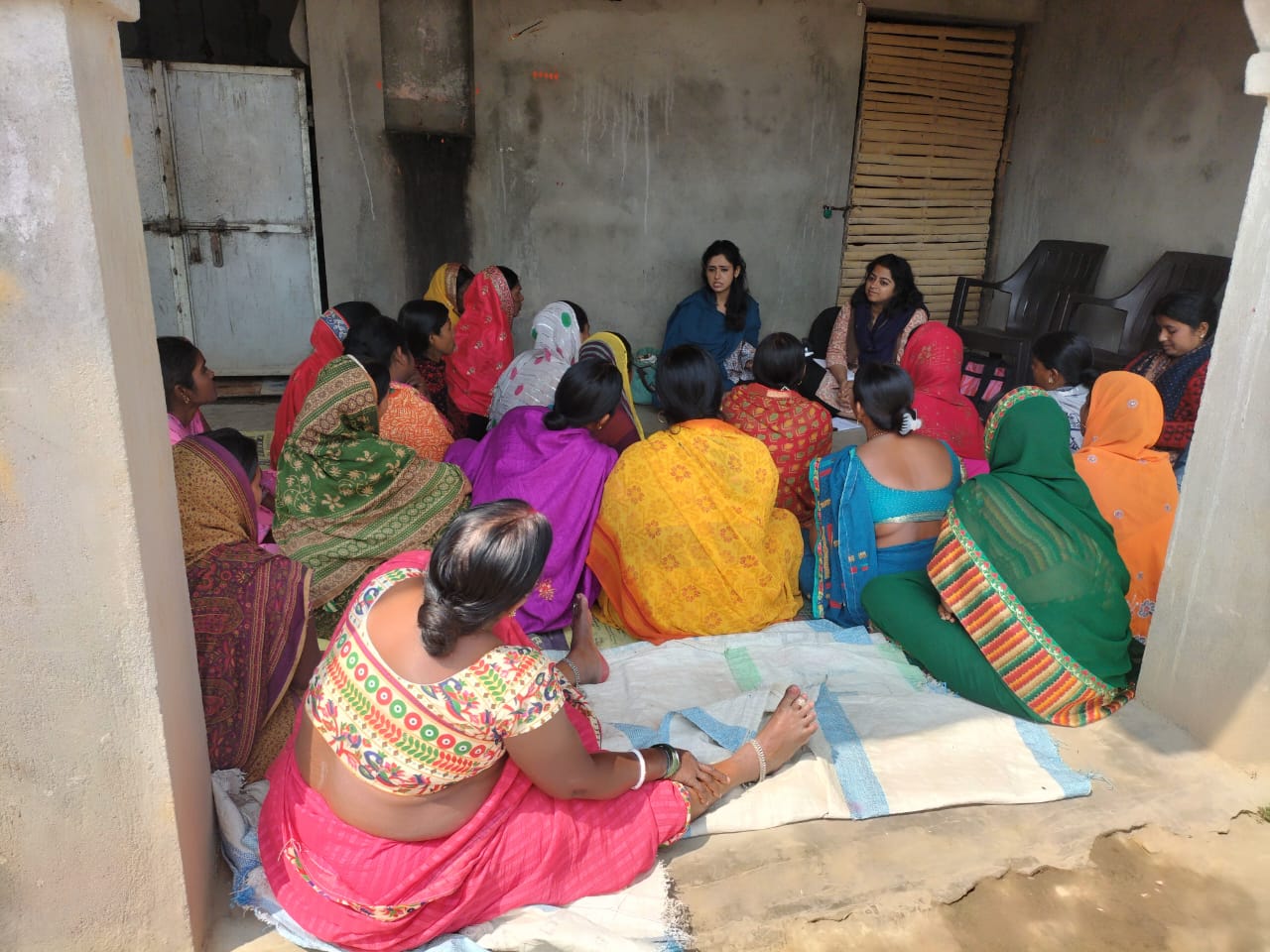
Two years ago, Neymat and I were in Lalganj block of Vaishali district in Bihar, sitting within a temple complex dedicated to Shiva, discussing menstruation with women. Talk about breaking barriers and taboos. The former sociology student in me was amused at the juxtaposition of hearing, “Pooja paath nahi kar sakte, mandir nahi ja sakte” (We can’t pray, perform rituals or go to the temple while menstruating) while sitting next to a temple.
This was day four of talking to groups of women in Bihar – graciously sharing their time and stories – on a rather rapid research trip. This formative research was a deliberate methodological phase meant to inform our research design – listening to women and paying attention to how they talked about their lives, their bodies, their health, their contexts. In Bihar, the formative phase of SAHELI would not have been possible without collaboration and support from SEWA, PCI and JEEViKA. While the findings from the three states were certainly formative to the SAHELI approach, this experience proved to be formative for me in more ways than one.
Prior to SAHELI, my qualitative work led me to speak to those shaping the health system and delivering services. I had little to no experience with speaking to women as research participants and (occasionally non) recipients of this health system. Neymat, on the other hand, was experienced: fresh from her embedded, intense, anthropological PhD fieldwork with women who had undergone hysterectomies in Maharashtra. I was happy to let her take the lead while I listened and built confidence.
Neymat and I began in Patna, made our way to Munger, Vaishali and back to Patna, while catching glimpses of Gangaji. The unique strength of collaborating with SEWA (India’s largest trade union for women in the informal economy) and JEEViKA SHGs (amongst India’s largest rural women’s empowerment programs) meant speaking to women from diverse occupations and backgrounds. These included groups of entrepreneurs, street vendors, homemakers, SHG members and domestic workers. Inevitably, across groups, the common (public) space of choice to talk about their menstrual health: the local temple.
Some of what struck me and has stayed since that visit:
I learnt about the sheer range of gynaecological concerns women face. I had been oblivious to white discharge/dhaat/safed paani/“licoria”. “Shayad hi 1-2 ho 100 mein jinko dikkat nahi hai” (There are hardly 1-2 in 100 who don’t have a problem). They commonly attributed this to body heat which could be countered by consuming cold items. Very few admitted to having resolved this problem – it recurred and followed the same (non) treatment cycle.
In each group of 20 women, we came across at least 3-4 who had undergone hysterectomy at younger ages. They reported a wide range of reasons that possibly had nothing to do with actual indications for the surgery: abdominal pain, fatigue, white discharge, abnormal bleeding and occasionally, an artificially constructed fear of cancer by providers. “Bachadaani gal jaata hai”(Uterus becomes rotten) or “Bachadaani mein kharaabi ho gaya”(Uterus has developed a problem). Nearly no woman reported feeling better post hysterectomy. “Free” ho jate hain, par shareer nahin bachta”(We get free but there is nothing left of the body).
During my Master’s degree, I had become obsessed with questioning female sterilisation. My dissertation explored the role it played in family planning in India – through the perspectives of policymakers and ASHAs. Critically, of course, it missed perspectives of women. This was one of the first field visits where I had met several women who had undergone sterilisation – one of them even referred to it as a “youtube ka operation” (tubectomy). They matched the age and fertility trends I had learnt of and reported. The way they talked about it made it sound like a routine, nonchalant happening in their life. It almost made me question my own anger about whether this had been a “choice”. Then again, this was not the main thread of enquiry during these discussions and perhaps something I’ll continue to explore in my research work.
We learnt about their perceptions of menstruation, taboos, and the impact this had on their livelihoods. “Main nahin karungi toh kaun karega. Ek mahila k liye koi aur doosra upaay nahi hai.” (If I don’t do it, who will?) At the risk of oversimplifying, this was the undercurrent in many discussions. The women talked of their health concerns in a matter-of-fact way. They shared willingly but with a rather resigned attitude. It felt rather empty to leave them with trite suggestions like going to the local government health facility (not knowing whether it is close by or equipped to help them).
To end on a lighter note, some of the women were curious to know whether I was married. You see, I carried none of the expected, traditional markers. I waved my plain wedding band and said “yes, for three years now”. “Lagta hi nahi hai. Babua toh hoga na?” (That plain band means nothing to us. Three years! Do you at least have a child?”) I told them I didn’t – right now, I was focused on travelling and meeting them. There was an immediate, “Lagta hai madam abhi paisa kamaane par focus kar rahi hai. Koi baat nahi, aap le aana agli baari, babua toh hum sambhaal lenge side mein.” (Looks like madam is focused on earning money right now. No worries – just bring the baby next time, we’ll take care of him.)